
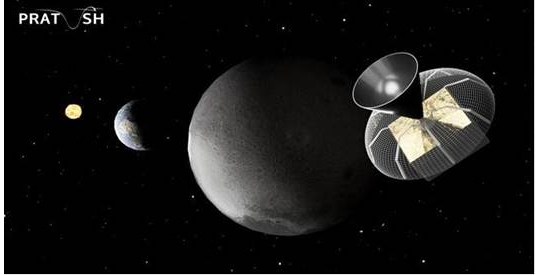
Scientists believe this mysterious epoch holds the key to understanding the Universe as we see it today, making it an irresistible frontier for discovery. However, very little is known about this period due to a lack of precise observations.The first of its kind proposed space payload, PRATUSH (Probing ReionizATion of the Universe using Signal from Hydrogen) by a team from Raman Research Institute (RRI), an autonomous institute funded by the Department of Science and Technology (DST), Government of India is designed to unlock this mystery.
It is a future radiometer in lunar orbit that will answer questions about the first stars formed in our universe.In keeping with space science’s long-standing focus on low-mass, high-capability payloads, PRATUSH demonstrates how a compact controller can shoulder precision radio measurements. This can help detect a faint radio signal emitted from hydrogen atoms (21-cm signal), which carries imprints of several events of the Cosmic Dawn. Capturing this signal is like hearing a whisper in a stadium full of noise because it is buried under interference, millions of times stronger than the signal itself.